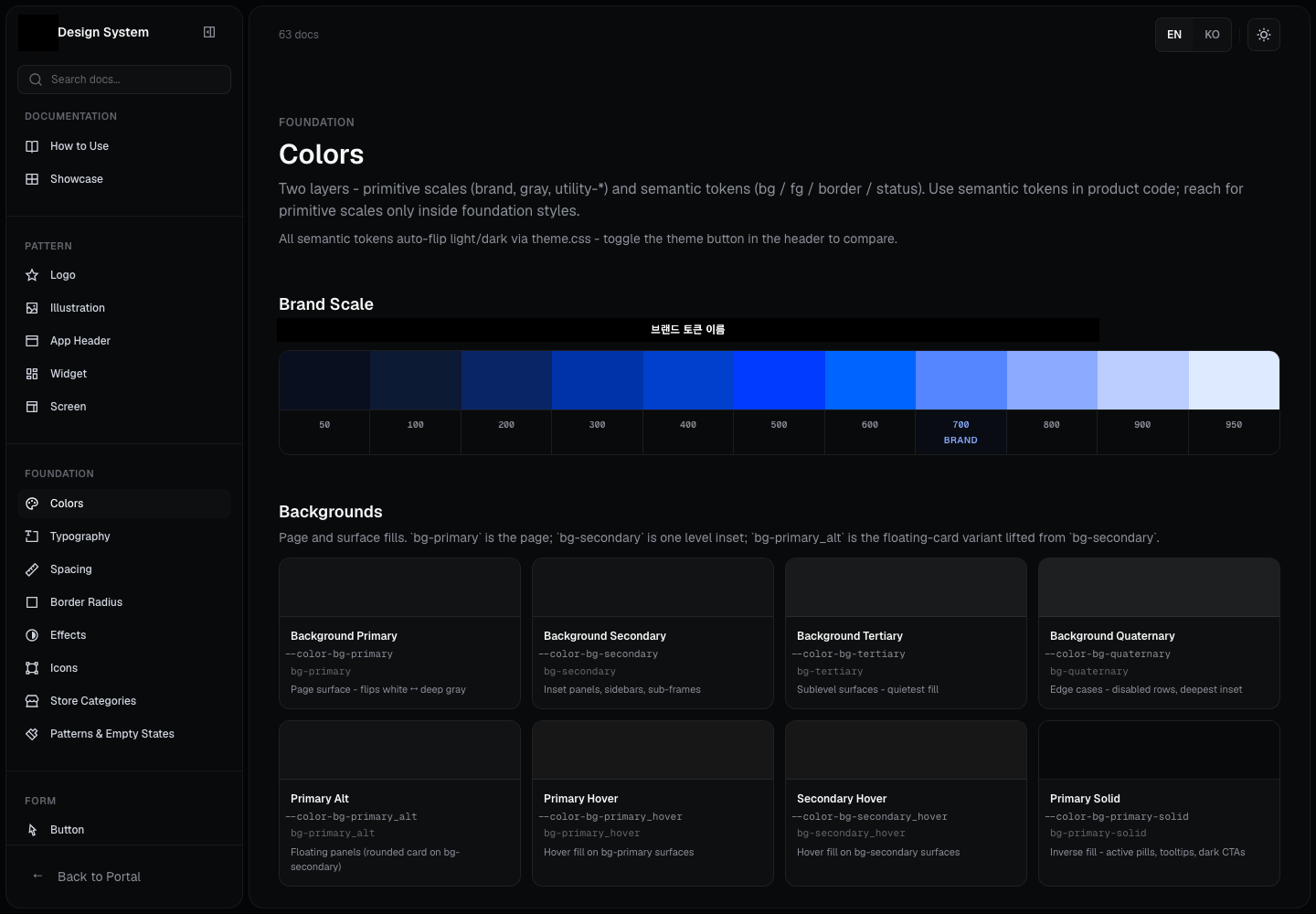
The problem
The design files and the shipped screens had drifted apart. Change a color in the file and the screen stayed as it was; patch a value in a hurry on the screen and it never made its way back into the file. Both claimed to be the source of truth, so every question had two answers, and in the end a person compared the two by eye every single time.
The source of truth moved into code
The design tool was not abandoned. It is simply no longer the source of truth. Exploration and early concepts still happen there, but the answer to "which screen is correct" now lives in one place: the code that actually runs. The reasoning is plain. Synchronization maintained by human comparison is the first thing to break when the team is busy, and when it breaks it leaves no trace.
The system itself was split in two layers. Primitive tokens carry values; semantic tokens carry meaning. Screens reference semantic names only and never reach for a raw value. Without that boundary, someone has to decide "is this blue the brand color or the informational color" on every use, and that decision differs from person to person.
Failure modes closed by structure
Defining tokens was not enough. What actually broke was never the rule itself but the places where a rule passes silently.
- A missing dark-theme counterpart still built successfully. A completeness check now catches tokens that exist in the light theme and not the dark one
- When the scan glob is written by hand on the consumer side, matching zero files still passes the build. The build goes green and only the screen is broken. The glob was moved inside the package
- Importing a single preset now pulls the fonts along with it. "Forgetting the font import" was removed by structure rather than guarded by a note
- Using an undefined color step rendered transparent with no warning. Only semantic names are permitted, so the mistake can no longer be expressed
The same piece was redrawn once per product
When the fourth product arrived, the same thing had been built four times. Badges, dropdowns, category icons, stat cards, the pieces every product has. Every one of them worked well enough, so nobody ever filed it as a problem. It surfaced when something had to change. Adjusting the padding on a badge meant finding four places, and the four had drifted enough that it was not the same edit in each. Miss one and that product kept the old shape, and the fact that it was old was invisible until the two were placed side by side.
Counting the duplication was the first thing that stalled. Asked "how many screens are there," product counted from the spec table of contents, engineering counted routes, design counted mockups. Three different numbers, none of them wrong; they were counting different units. So the unit of counting was fixed to the URL. A screen is a human concept and needs agreement; a URL either exists or it does not. The list is extracted from the code rather than typed by hand, and on top of it a board gives each product a row of cards carrying state and the product area that owns it, so product, engineering and design all look at the same board. Counted from the code instead of from memory, two things surfaced at once: a preview copy and a package copy had diverged, and an older and a newer generation of the same product were coexisting. Before that, a review had once run off a screen list and missed five pages that existed only in the deployed build. They were not on the list, so they were not in scope, and the review passed.
Promotion became a state rather than an agreement
I decided not to settle each promotion by agreement. Agreements get skipped when things are busy, and a skipped agreement leaves no record.
Instead every screen and shared piece carries a handoff state: draft, review, stable, retired. The moment something turns stable is the moment it becomes a promotion candidate. Nobody has to ask whether it is time to lift it, because the state already says so.
The structure splits into one shared core and four per-product packages. The core leans on no product, and product packages use the core without referencing one another. Without that direction fixed up front, the shared layer grows around one product's circumstances, and later the others cannot use it.
What kept blocking promotion
Even after the process existed, promotions kept failing, and they failed where the rules and reality had drifted apart. A screen leaning on the shell or on shared fragments broke the moment it was pulled out; the same route appeared twice in the list carrying two different states; more than a hundred screens were already deployed while the list still had them in review.
All of it was caught by eye, and catching things by eye works once and stops working the second time. So promotion is now read from the actual package composition rather than from the list, and displayed automatically. When the list and reality disagree, a check blocks the change, and I tightened it to block edits into review as well as into stable.
The outcome
Changing one color went from opening dozens of files to editing a single token, and changing a shared piece became a change in one place. The question "is this screen shared?" no longer comes to a person; the screen answers it. Promotion became an outcome of the process rather than of somebody's diligence.
What I keep thinking about
Making the standard singular has a cost. Design discussion moved into the code review path, which raises the barrier for non-engineering colleagues. The browsing board was built to offset that. But standing a board up does not by itself build the habit of reading it, and that part this design did not solve.