What this screen is
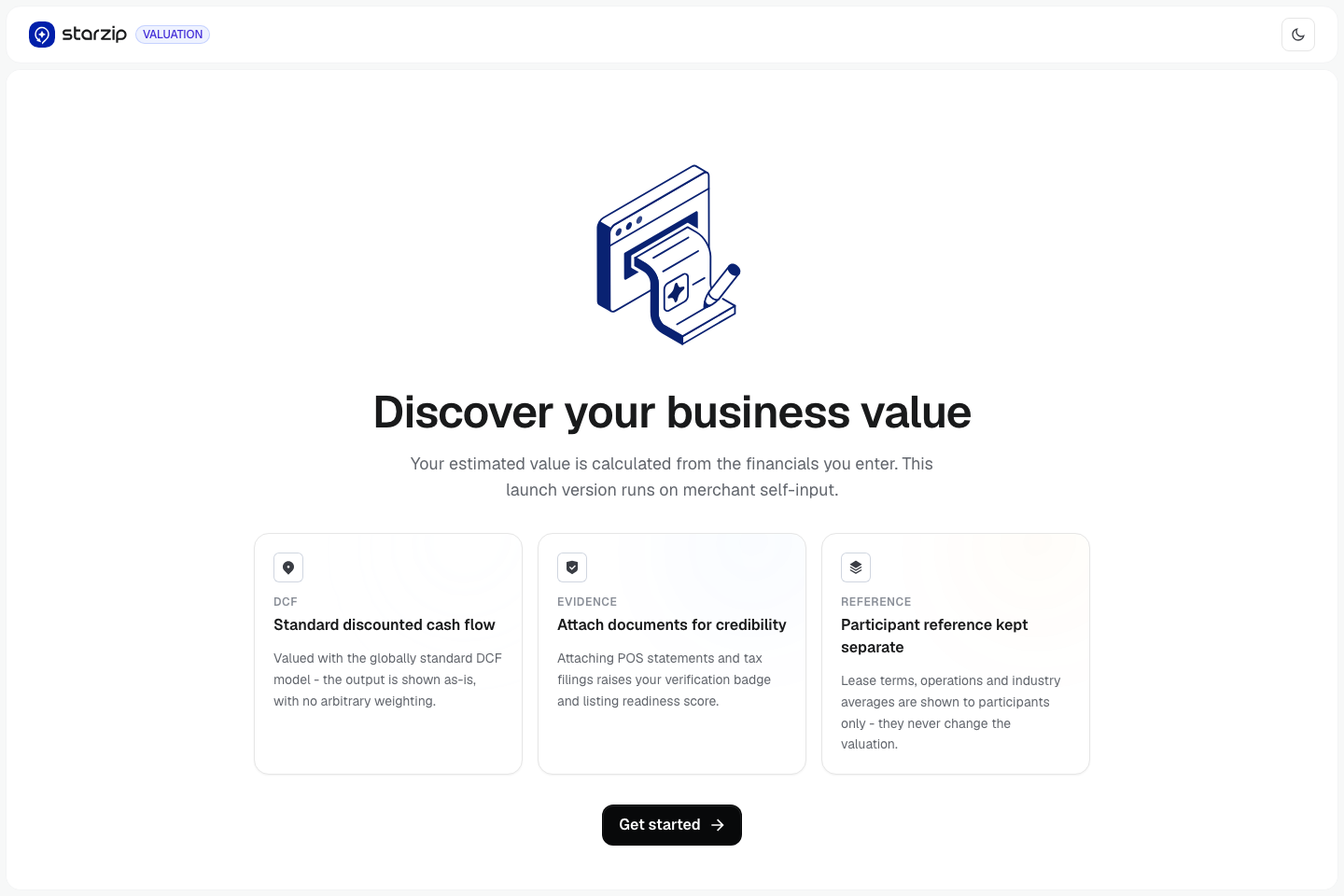
Starzip is a product where a local store issues a token under its own name. Before issuing, the store has to arrive at some sense of what it is worth, and the owner of a cafe or a restaurant has no ready way to produce that number. A professional appraisal costs money and time, and nobody pays it before deciding whether to issue at all.
So this screen is a self-assessment the owner runs themselves. One method computes the value and we lay no weights on top, because the moment we touch the number it stops being the store's value and becomes our verdict. The people who open this screen are stores that have not entered the product yet, and the ones who meet those stores are partners rather than us. That is why it had to go outside.
The problem
The request was to use the store valuation screen from outside the company and hand partners a link to it.
At the time the screen lived only inside the corporate network. Getting it outside meant building that screen on its own. All the screen code ships in one bundle, so simply opening the address sends out screens that have no reason to leave.
Splitting access permissions screen by screen was also available. But when the thing that needs to go out is a single screen, that path adds rules to keep. Added rules have to be kept again every time a screen is added, and the fact that one was not kept only shows up once something goes wrong.
The judgment: I built only the part that goes out
The source stays together and only the release artefact is split. A reduced router imports just the screen that goes out, and the build runs through that router.
- A screen that is never imported never ships. That makes the one file listing what is imported the definition of what is exposed. The boundary is an artefact rather than a rule, so there is never an occasion to check whether it is being kept
- The first artefact came out at 136MB, because the build tool copies the static asset folder wholesale and the internal assets came with it. Splitting off a dedicated folder and keeping only the files actually used brought it to 1.8MB
- The in-house development tooling came out too. The screen switcher and the links into internal documents must not be visible from outside
- Verification was not done by eye. I served the built artefact and opened the internal paths one at a time, comparing responses to confirm they all fall back to this screen. The internal assets are simply not in the artefact
What I decided not to do
No crawler-blocking file. It went into the requirements once and then came back out.
Blocking the crawl and blocking the index are different jobs. Block the crawl and the robot never reads the page at all, which means it never sees the no-index marker already sitting in the document. If a link to the address exists somewhere out there, the address can then surface in search results with no content behind it. That is a worse place than the one we were avoiding. The marker on its own is safer.
No password either. The purpose was for partners to receive a link, and a password travels in the same message as the link it protects. That looks like protection without being any. Instead we closed the path where search leads people in, and decided that nothing in the product links to this address.
Outside, the same sentence stands somewhere else
While the screen sat behind the firewall its wording was not exposure. The moment the address goes out, those same sentences move into a position where people outside the company read them as grounds for judgment. So the wording was revised alongside.
- A footnote on the result screen described itself as reference material for a decision. That sentence came out. What a screen declines to claim has to be settled as deliberately as what it claims
- A button that did nothing came out. There is no reason to leave a dead control on a screen that shows figures with no server and no save behind it
- The save-draft button came out as well. Values were already being saved automatically, so the button had no work to do. Leaving it as a button reads as nothing being saved unless you press it, which to an outside reader implies the values are kept on a server
- That last one changed the internal review screen too. Once the screen under review and the screen partners see diverge, nobody looks at the one that diverged
Input values never go to a server; they stay in the browser. The retention window counts from the last time the person touched it. Counting from the first entry would take the values away mid-task from someone gathering their paperwork across two days.
The result
One screen opens outside the corporate network, and the rest of what shared its bundle does not exist at that address. The boundary is an artefact rather than a rule, so it does not blur as time passes.
What I could not settle is worth recording too. How it reads, from outside, for a company to publish a tool that computes a value and presents it at a public address was not mine to decide. What the screen says and on what terms it opens was my part; the character of the act went to the people who judge that. I did not hold the release while that judgment was pending. Going public was the reason to ask for it sooner.